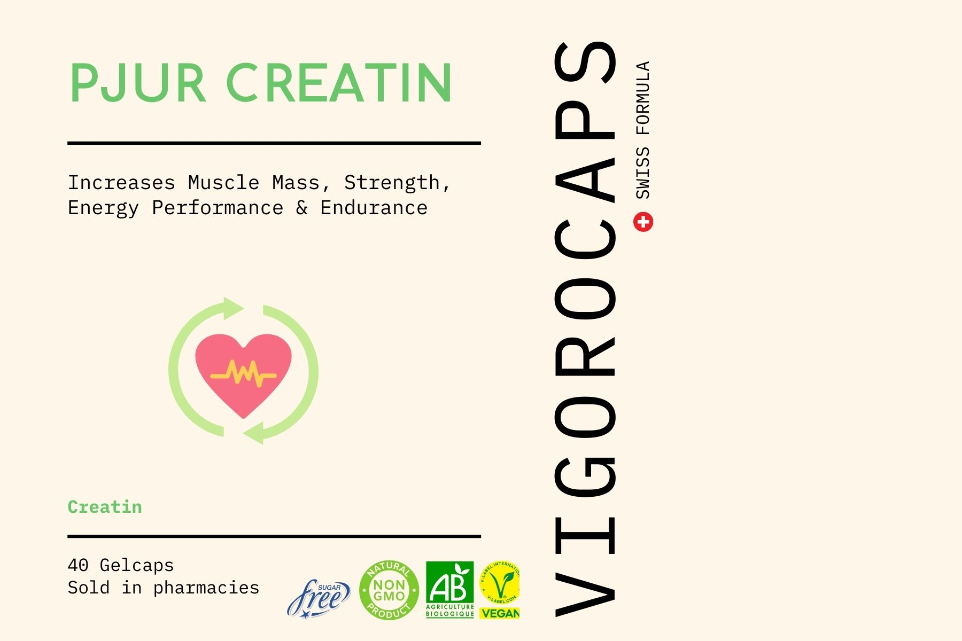
Creatine Monohydrate
Benefits of Creatine Monohydrate:
- Strength Gain
- Increases Muscle Mass
- Improves Energy Performance
- Enhances Endurance
Whether you're a passionate bodybuilder, a CrossFit athlete, or an endurance sports enthusiast, creatine is one of the most powerful and effective supplements for improving your performance, strength, and recovery. Scientifically proven, used for over 25 years, and widely praised in the sports world, creatine monohydrate remains the gold standard.
In conclusion: Integrating creatine monohydrate into your workout routine is essential.
En conclusion: intégrer la créatine monohydrate à votre routine sportive est indispensable.
During intense training (weightlifting, CrossFit, explosive sports), your phosphocreatine stores are continuously used to produce energy. Creatine helps to:
✔️ Strengthen muscle strength
✔️ Improve recovery
✔️ Promote muscle gain
A daily dose of 3 to 5g of creatine monohydrate is enough to improve performance, increase strength, and stimulate muscle growth. Dozens of scientific studies have validated its effectiveness over the past 20 years.
For bodybuilders, 3 to 5 grams of creatine per day will deliver positive results on strength and muscle growth in the medium term.
For CrossFit athletes, the same dose can be advised, either before or after training. Remember that taking it before exercise will increase strength, but taking it after will help with better recovery.
For athletes practicing team sports or endurance sports, we recommend 3g of creatine per day.
For team or endurance sport athletes, they can take 3g of creatine after their workout or training session, which will aid in recovery.
Pour les athletes pratiquant des sports d’équipe ou d’endurance, ils peuvent prendre les 3 gr de creatine après leur efforts ou leur session d’entrainement, cela facilitera la récupération.
Vegetarian athletes are among the profiles that benefit the most from creatine supplementation.
Not consuming meat or fish, the only natural sources of creatine in the diet, their reserves are often much lower than their optimal potential.
Creatine monohydrate thus becomes an indispensable asset in their daily routine.
Creatine proves to be a real accelerator for faster progress and becomes a true game-changer.
Creatine monohydrate is the most tested, stable, and effective form. It offers rapid and lasting results without posing health risks.
Creatine monohydrate is the most sold form of creatine in the sports nutrition market. Sold for over 25 years, creatine monohydrate has been tested in hundreds of scientific and clinical studies for its effectiveness and lack of side effects
Creatine Loading Phase (High Doses of Creatine for Several Days):
Some scientific studies have tested very high doses of creatine for 4 to 8 days to validate a laboratory hypothesis. In practice, no real advantage has been observed with a loading phase compared to regular intake of 3 to 5g of creatine per day.
On the contrary, excessive loading may lead to water retention outside the muscles, which is neither comfortable nor useful for your performance or physique.
Our advice: There's no need to overload your body. A moderate daily intake is more effective, stable, and better tolerated.
Continuous or Cyclical Creatine Use:
Both options are possible, depending on your preferences and goals!
- Continuous: Ideal for maintaining a constant level of creatine in muscles and maximizing performance over the long term.
- Cyclical (by cycle): Practical if you want to integrate it into a mass-gaining phase or a muscle-strengthening period.
No worries: when you stop, your body will naturally resume its own production without rebound effects.
In conclusion: 3 to 5g of creatine per day is enough to optimize your energy, strength, and training results – without overload, without a loading phase, just pure performance.
3 à 5 g de créatine par jour suffisent pour optimiser votre énergie, votre force et vos résultats à l'entraînement – sans surcharge, sans phase de charge, juste de la performance.
Generally, creatine taken before exercise boosts strength, while taking it after training aids in post-workout recovery. It should be consumed on both training and rest days, as the effects of creatine increase progressively with rising plasma and intramuscular levels.
Taking creatine for several months or years at an average dose of 4g/day has shown no side effects in the study subjects.
References: Bender et al., "Long-term creatine supplementation is safe for elderly patients with Parkinson's disease," Nutr Res. 2008 Mar; 28(3):172-8. Galvan et al., "Acute and chronic safety and efficacy of dose-dependent creatine nitrate supplementation and exercise performance," J Int Soc Sports Nutr. 2016; 13: 12. Richard B. Kreider, Ralf Jäger, Martin Purpura, "Bioavailability, effectiveness, safety, and regulatory status of creatine and related compounds: a critical review," Nutrients. March 2022; 14(5): 1035. Schilling BK et al., "Creatine supplementation and health variables: a retrospective study." Med Sci Sports Exerc (2001).